The Moon is no longer a Destination. It’s a Balance Sheet.
Inside the $127B Lunar Economy Taking Shape Under the Artemis Campaign
The Artemis Campaign: Architects of the Integrated Lunar Economic Ecosystem
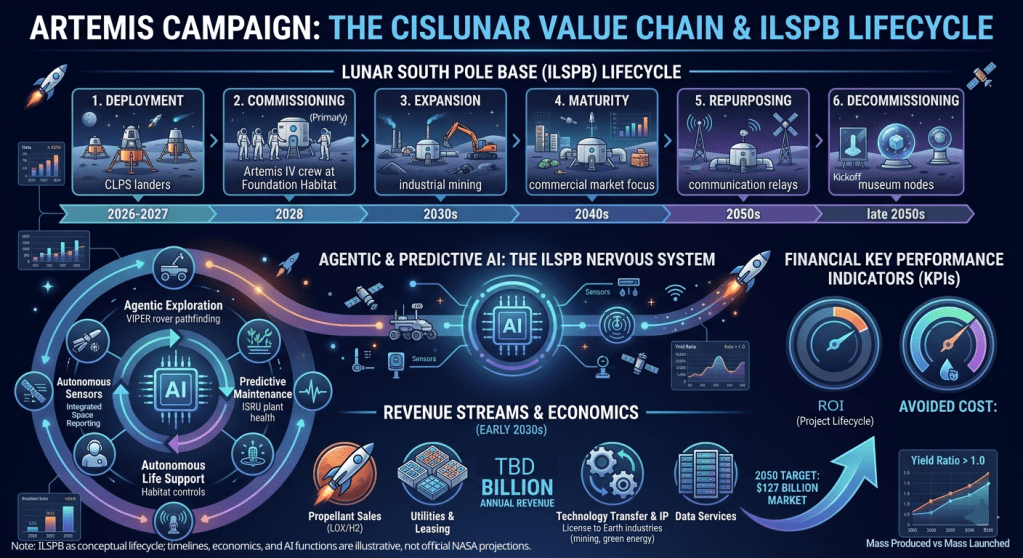
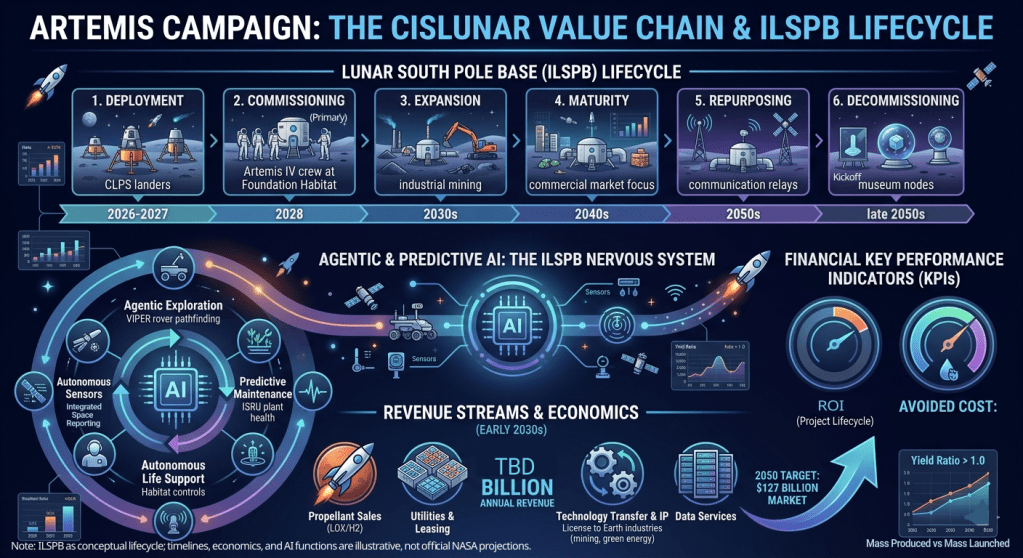
The Moon is no longer a destination—it’s a balance sheet. 📊 While the world watches for “flags and footprints,” the real transformation is happening in the quiet shift from exploration to a permanent industrial presence. We are witnessing the birth of the 🏗️ Foundational Age of lunar infrastructure, where Aerospace Engineering meets Enterprise Architecture to cultivate a scenario‑based lunar economy projected at $127.3 billion [1].
Strategic Intent: From Exploration to Industrialization 🏭
The core Business Strategy focuses on establishing the NASA Artemis Base Camp in the early 2030s, with the conceptual objective of having an 🚀 Integrated Lunar South Pole Base (ILSPB) evolve into a permanent resource node over time. By prioritizing In-Situ Resource Utilization (ISRU), particularly the extraction of water ice and oxygen, planners are securing international leadership through a self-sustaining ecosystem [2]. This positions the lunar surface as a potential critical asset in the 💎 Cislunar Value Chain, treating resource sovereignty as an emerging driver of orbital competitiveness.
The Tactical Shift: Integrated Life-Cycle Management ⚙️
Following a strategic pivot in early 2026, the campaign has adopted a more sustainable mission cadence, utilizing 📐 Project Management best practices to mitigate technical and schedule risks. Artemis II performs the first crewed lunar flyby in over 50 years and validates deep‑space systems, while Artemis III is viewed as a mission to further validate docking, mobility, and surface operations [3]. This modular approach ensures that every segment of the value chain—from prospecting to logistics—is integrated into a broader 🏛️ Enterprise Architecture that supports long-term industrial viability [2, 4].
The Operating Model: The Multi-Service Hub 🔌
The surface base operates under a 🤝 “Commercial-First” framework, a significant departure from legacy government-owned models. NASA is strategically positioned as an anchor tenant, shifting its Operating Model toward purchasing 💳 “Utilities-as-a-Service” rather than maintaining hardware assets [5]. Standardized docking and power interfaces allow private modules to plug into a shared grid, while ⚛️ fission surface power projects aim to maintain continuous operations through the 14-day lunar night, supporting the level of Operational Excellence required for industrial-scale output [5, 6].
Economic Drivers: The Cislunar Revenue Landscape 💵
Value in this frontier is driven by commodities and the monetization of Intellectual Property. ⛽ Liquid oxygen produced from lunar ice for refueling Mars-bound spacecraft represents the cornerstone of propellant sales [2, 4].
Additional scenario‑based revenue streams include:
- 🚀 Propellant depots supporting Mars and deep‑space missions
- 📡 Lunar communications relays enabling surface‑to‑orbit data flow
- 🤖 Navigation and positioning infrastructure for autonomous systems
- 📦 Logistics hubs for cargo transfer and surface mobility
- 🏗️ Infrastructure leasing for power, thermal control, and communications
NASA explores multiple technology areas, including 🩹 self-healing systems, materials, and software to enhance resilience and sustainability [10]. These innovations generate technology spillover benefits for terrestrial industries such as ⛏️ mining, energy systems, and advanced manufacturing [7, 8].
Fiscal Rigor: Financial Planning & Analysis 📈
A rigorous 📊 FP&A approach reveals the scope of this frontier economy, which relies on a massive capital foundation. The total investment can be framed as approximately $110 billion in new infrastructure development, based on scenario‑based modeling [9, 2]. Profitability hinges on critical 🎯 Key Performance Indicators (KPIs) such as the Yield Ratio and the “Avoided Cost” of producing water in-situ, which drastically reduces the expense of launching mass from Earth [4].
The Digital Nervous System: Agentic & Predictive AI 🧠
Artificial Intelligence serves as the nervous system of the base, managing complexity where human intervention is a luxury. Autonomous rovers utilize 🤖 Agentic AI to interpret high-level goals and perform real-time mineral mapping without Earth-side latency [2]. Conceptually, Business Process Management (BPM) integrated with 🔮 Predictive AI could support “self-healing” supply chains and anticipate component fatigue in extreme environments [8, 10].
Project Lifecycle: From Launch to Industrial Scale 🏁
The initiative follows a strict Project Lifecycle that begins with the Artemis II mission. NASA expects to reach foundational surface habitat capabilities by 2028, with the establishment of a permanent base and ⛏️ pilot‑scale ISRU operations emerging in the early 2030s [3]. Ultimately, retired assets are slated for repurposing as communication relays to minimize orbital debris and support a sustainable footprint.
Lessons for Business Leaders 💼
🔹 Infrastructure precedes markets — Frontier economies grow only after foundational systems exist.
🔹 Anchor tenants de‑risk ecosystems — NASA’s role mirrors terrestrial industrial development patterns.
🔹 Modular architectures accelerate innovation — Flexibility is the competitive advantage in extreme environments.
✏️ Alejandro Velasco, CC BY, March 17, 2026 Managing Director | Strategic Operations & AI-Enhanced Consulting

At TRANSBACO, we specialize in the 📈 Strategic Operations and 🧠 AI-Enhanced optimization required to transform these architectural concepts into profitable business realities. As we launch our brand, we are offering specialized 💼 Business Consulting Services to help organizations navigate and capitalize on their Value Chain.
📖 References:
[1] PwC (2026). Lunar Market Assessment – 2nd Edition. | [2] NASA (2023). Lunar Surface Science & ISRU Overview. | [3] nasaspacenews. Artemis Program Update. | [4] NASA. Growing Lunar Economy. | [5] NASA (2022). Lunar Surface Sustainability Concept Study. | [6] NASA (2023). Fission Surface Power Project Overview. | [7] NASA (2023). Autonomous Systems & Fault Management. | [8] Nature (2024). Robot, repair thyself. | [9] NASA OIG (2024). Top Management Challenges. | [10] NASA (2021). Self-Healing RF/Microwave Communications. | [11] NASA (2024). Commercial Lunar Payload Services (CLPS) Manifest.
Disclaimer: This article contains scenario‑based strategic projections informed by publicly available NASA concepts, industry analyses, and historical cost data. All financial figures, timelines, and technology descriptions are illustrative and subject to change based on evolving mission requirements, technological progress, and geopolitical factors. The views expressed are for analytical and educational purposes only and do not represent official NASA positions or constitute investment advice.
#LunarEconomy #Artemis #EnterpriseArchitecture #CislunarValueChain #IndustrialEngineering #SpaceInfrastructure #AI #FPandA #OperationalExcellence #SpacePolicy #ISRU #MoonToMars #AlejandroVelasco #TRANSBACO
 TRANSBACO
Leave a comment